





Meeting the Mark: Setting Lambs Up for Success

This article outlines best-practice lamb marking practices to improve animal welfare, recovery and lifetime performance. It covers preparation, hygiene, low-stress handling, correct tail docking, effective pain relief, ewe assessment and post-marking care, with practical tips to help WA woolgrowers set lambs up for success.
Lamb marking, when done well, provides lifelong protection against flystrike, supports animal welfare and sets lambs up for improved lifetime performance. With pain relief now widely adopted across much of the Australian wool industry, winter marking provides an opportunity to combine best-practice husbandry with the latest welfare tools to improve lamb welfare and performance following marking. Even if you’ve already completed marking this year, staying up to date with the latest best practice will help ensure you stay ahead of the game in the future.
Preparation and Planning
Timing and Weather
The recommended age for marking and mulesing lambs is between 2 and 8 weeks of age. Marking at this age is generally less stressful for lambs, avoids the challenges associated with handling older, heavier animals and provides protection against increased spring flystrike risk. So if you haven’t done your marking yet and your lambs are in this age range. It’s time to get them in.
Weather conditions also influence recovery. Aim to mark lambs during fine, cool conditions and avoid wet, muddy or extremely windy weather, which can increase the risk of infection and slow healing. Start work early in the morning and finish by early to mid-afternoon. This ensures that when the mob is released, ewes and lambs have plenty of daylight to successfully "mother-up" before nightfall, significantly reducing the risk of mismothering.
Yards and Hygiene
Good preparation and hygiene can significantly reduce complications following marking. Where practical, it is preferable to use portable temporary yards on clean pasture, ensure equipment is properly disinfected before marking and release the lambs onto clean paddocks to prevent post-surgical infections and minimise the distance lambs need to travel. If using permanent yards, ensure they are cleaned out beforehand and manage muddy areas where possible.
Equipment should be cleaned and disinfected regularly throughout the day, with disinfectant solutions replaced frequently to maintain effectiveness. Clean equipment and clean environments are simple but effective ways to support lamb health and recovery. Woolgrowers should consider using a 10L container with water or mild disinfectant to scrub off blood and faeces, alongside a separate 5L container of strong surgical disinfectant for clean instruments to soak in before use. Remember to change these solutions regularly throughout the day.
Best-Practice Marking Procedures
A well-organised marking operation helps minimise handling time and stress. A recommended order of procedures is:
- Vaccination
- Ear marking and tagging
- Castration
- Tail docking
- Mulesing (if required)
- Pain relief
- Apply a preventative insecticide to reduce flystrike risk
Marking provides an ideal opportunity to vaccinate lambs against diseases such as tetanus and pulpy kidney. Vaccines should be stored according to the label directions and administered correctly to ensure maximum protection. Most vaccines must be stored in the fridge at 2–8°C before use and never frozen. Keep vaccines cool and out of direct sunlight while working in the yards.
Docking the tail at the correct length (the 3rd or 4th joint) is a vital procedure to reduce lifetime susceptibility to breech flystrike. For ewe lambs, the healed tail should cover the vulva, while for wethers it should cover the anus. Tails docked too short can increase the risk of flystrike and other health issues, while tails left too long can create management challenges later in life.
Careful handling reduces stress and injury. Lambs should be caught and supported around the body rather than dragged by the legs. When releasing lambs from the cradle, ensure they are placed on their feet to minimise contamination of fresh wounds.
Pain Relief Options
Pain relief has become standard practice across much of the Australian wool industry, with the majority of mulesed Merino lambs now receiving treatment. Pain relief is just as important for non-mulesed flocks. The use of pain relief not only improves animal welfare outcomes but can also support faster recovery following marking.
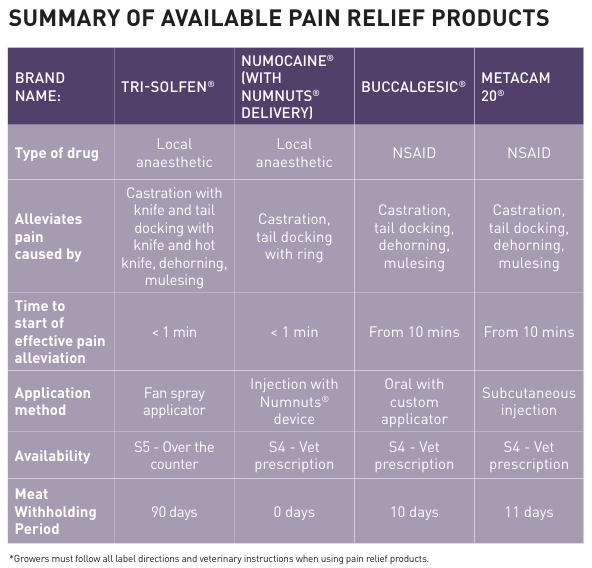 Image Source: AWI
Pain relief products generally fall into two categories:
- Fast-acting local anaesthetic - provides immediate pain relief at the treatment site
- Longer-lasting anti-inflammatory products (NSAIDs) - help reduce pain and inflammation during the recovery period
Commonly used products include Tri-Solfen®, Numnuts®/NumOcaine®, Buccalgesic® and Metacam® 20.
Tri-Solfen® must be applied to open wounds (such as mulesing or surgical tail docking) and does not provide pain relief for rubber rings. NumOcaine® (via the Numnuts® device) is the appropriate local anaesthetic specifically designed for ring castration and tail docking.
Note that slower-acting NSAIDs (like Buccalgesic® and Metacam® 20) take about 10 to 15 minutes to reach optimum blood concentration. Therefore, they are best administered at the start of the handling process so the circulating level of pain relief is fully active when the tissue damage occurs.
Research has shown that a multi-modal approach, combining a local anaesthetic with an anti-inflammatory product, provides the most effective pain management. This approach addresses both the immediate pain associated with the procedure and the inflammation that occurs during healing.
It is recommended that woolgrowers consult their veterinarian to develop a pain management program suited to their enterprise and ensure all withholding periods and product requirements are met.
Assess Ewes as ‘Wet’ or ‘Dry’
While the lambs are being processed, marking provides the perfect opportunity to assess your ewes while they are in the yards. Conducting a "wet-or-dry" udder assessment at marking is the most reliable way to identify the superior performers to retain in your flock, and the poor performers (passengers) to cull, ultimately lifting your overall reproductive efficiency. Check out this article for more information on this topic.
Meeting Market Expectations
Animal welfare continues to be an important consideration for wool customers around the world. Recording animal husbandry practices through the National Wool Declaration (NWD) allows wool buyers to identify wool produced under specific welfare standards and helps ensure clips can meet a range of market requirements.
Post-Marking Checks
The period immediately after marking is critical for recovery. The selected recovery paddock should provide adequate shelter, clean water and sufficient feed for four weeks, during which time the mob should not be mustered or disturbed to prevent healing scabs from cracking.
Key factors to consider include:
- Minimise the time ewes and lambs are separated
- Allow lambs to mother-up in a quiet environment as soon as possible
- Move mobs to paddocks with adequate shelter, water and feed
- Avoid unnecessary mustering or handling during the recovery period
Providing a low-stress environment after marking supports healing, reduces setbacks and helps lambs return quickly to normal grazing behaviour
Setting Lambs Up for Success
Best-practice lamb marking combines careful planning, good hygiene, low-stress handling and effective pain management. By adopting these practices, WA woolgrowers can improve welfare outcomes, support improved lifetime lamb performance and ensure their flocks are well positioned for the future.
Key Takeaways for WA Woolgrowers
- Mark lambs at 2–8 weeks of age
- Aim for clean yards, clean equipment and clean paddocks for the lambs to go to after marking
- Schedule marking during fine, cool weather where possible
- Dock tails at the correct length to reduce future flystrike risk
- Use low-stress handling techniques throughout the marking process
- Incorporate pain relief as part of best-practice lamb marking. Combine a local anaesthetic and NSAID for optimal pain management
- Record your practices through the National Wool Declaration (NWD)
- Allow lambs to mother-up quickly after marking
- Provide shelter, feed and minimal disturbance during recovery
For more information and to check out the resources used in this article, check out the following:
- Plan, Prepare and Conduct Best Welfare Practice Lamb Marking Procedures Training Guide - AWI
- Anaesthetics and Analgesics at Lamb Marking - AWI
- Anaesthetics and Analgesics Widely Adopted by Woolgrowers - AWI
Georgia Pugh, AWI Extension WA


